
Friuli's mountain villages are emptying while the towns around Udine grow
Between the 2001 census and 1 January 2026 Friuli Venezia Giulia's 58 mountain towns fell from 73,095 to 59,366 residents, while the 18 towns within twenty minutes' drive of Udine grew by 7.6%. What that means for buyers, and for sellers.
Published 23 October 2026
Twenty-five years, two groups of towns
The mountain area follows the Italian statistics office's definition of inland mountain terrain: 58 towns, from Carnia and Tarvisio to the Natisone valleys and Val Cellina. The ring around Udine is our own definition: the 18 towns within twenty minutes' drive of the city centre, without traffic, Udine itself excluded.
Since 2001 the mountains have dropped from 73,095 to 59,366 residents and the ring has risen from 97,128 to 104,546. The region overall has barely moved, yet 141 towns have lost people, 38 of them a fifth or more.
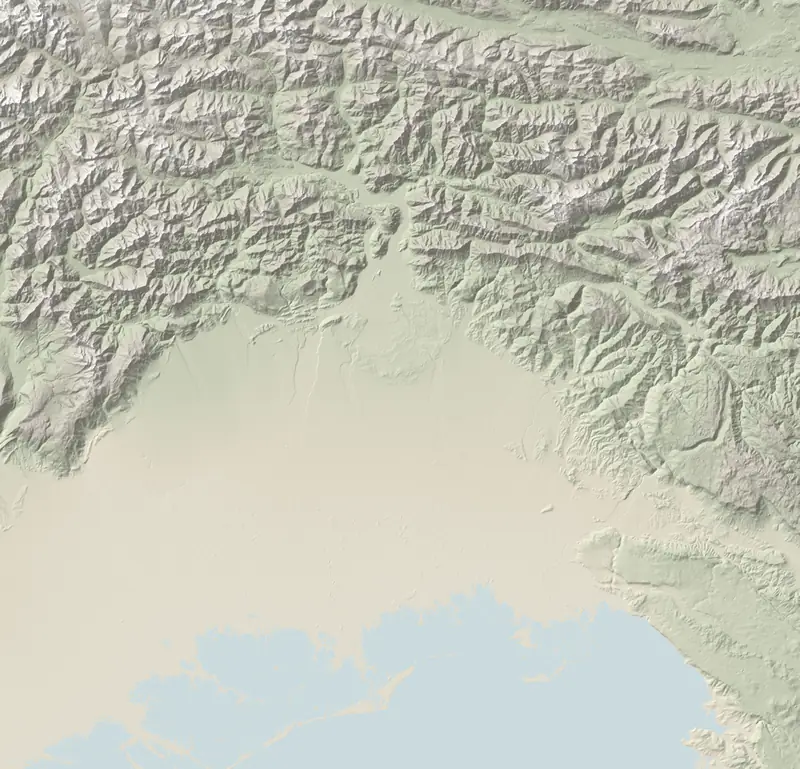
The palest dots, the heaviest losses, trace the whole Alpine and pre-Alpine arc; the darkest sit in the plain around Pordenone and near Udine and Monfalcone.
Where people leave, and where they go
| # | Municipality | Zone | Residents since 2001 |
|---|---|---|---|
| 1 | Drenchia | Cividale and the Natisone valleys | -55% |
| 2 | Savogna | Cividale and the Natisone valleys | -47% |
| 3 | Rigolato | Carnia and Sappada | -45% |
| 4 | Dogna | Tarvisio, Canal del Ferro and Val Resia | -43% |
| 5 | Grimacco | Cividale and the Natisone valleys | -39% |
| 6 | Stregna | Cividale and the Natisone valleys | -37% |
| 7 | Dolegna del Collio | Collio, Gorizia and the Isonzo | -35% |
| 8 | Comeglians | Carnia and Sappada | -34% |
| 9 | Tramonti di Sopra | Friulian Dolomites and Val Tramontina | -33% |
| 10 | Forni Avoltri | Carnia and Sappada | -33% |
The Natisone valleys on the Slovenian border head the list: Drenchia had 197 residents in 2001, has lost more than half of them, and its average age is 64.7. Carnia and the Canal del Ferro follow. Newcomers do arrive: in 2024, 31 of the 58 mountain towns gained more residents from the rest of Italy than they lost, and arrivals from abroad outnumbered departures by 168. But deaths exceeded births by 590.
The growing towns lie in the plain near Pordenone and Udine, where the city and its hospital are minutes away: from Tavagnacco the nearest round-the-clock A&E is 7 min by car, from Drenchia 57 min.
For buyers: cheap homes, thinner services
Homes cost less in the mountains: at OMI values a standard home is worth a median €650/m², against €790/m² region-wide, and €100,000 buys a median 155 m². The discount has a flip side:
- 7 mountain towns have no pharmacy;
- 23 have no primary school;
- the nearest A&E open day and night takes a median 28 min by car, against 18 min across the region.
| Drenchia | Rigolato | Dogna | Tolmezzo | Tavagnacco | Martignacco | |
|---|---|---|---|---|---|---|
| Residents since 2001 | -55% | -45% | -43% | -9% | 18% | 27% |
| Average age | 64.7 | 57.9 | 57.3 | 49.2 | 47.9 | 47.4 |
| Unoccupied homes (2011) | 60% | 63% | 71% | 12% | 15% | 8% |
| Standard homes (€/m²) | €520/m² | €740/m² | €600/m² | €930/m² | €1,290/m² | €1,100/m² |
| Pharmacies | 0 | 1 | 0 | 3 | 5 | 1 |
| 24h emergency room | 57 min | 32 min | 32 min | 2 min | 7 min | 15 min |
That does not rule the mountains out. Tolmezzo, the main town of Carnia, has a hospital, schools and pharmacies and has lost far fewer people. But the village matters as much as the house; drive times to hospital are covered in hospitals and A&E.
For sellers: plenty of competition, a little help
In 2011, 47% of mountain homes had no resident, and in 30 mountain towns unoccupied homes outnumbered occupied ones. Many are second or holiday homes rather than ruins, but buyers have a choice.
Two regional rules come into play. In towns classed as wholly mountainous, the Region gives a first-home buyer €15,500, against €10,500 elsewhere, for homes up to €200,000 and 120 m², but only to people who have lived in the region for 5 of the last 8 years: it helps the young local family, not the newcomer from elsewhere. And the local property tax, ILIA, reaches 1.06% on homes kept empty and not declared as a second home in 7 mountain towns; Bordano raised it for 2026 precisely to get idle houses used. A house standing empty costs money every year.
How to read these figures
- The 2026 figures are ISTAT's provisional count at 31 December 2025; 2001 comes from the census, mapped onto today's town boundaries.
- Figures for homes with no resident come from the 2011 census and count second homes too; the 2021 town-level figures, compiled with a different method, are not yet included here.
- Average age and the births, deaths and moves are for 2024.
- Minutes to A&E: driving time from the town hall, assuming no traffic.
- Pharmacies and schools are counted within town boundaries: the nearest may be in the next village.
- The Udine ring is our own cut-off on drive times without traffic: Mereto di Tomba, just over twenty minutes away, is left out.
Questions
Which villages in Friuli are losing the most people?
Since 2001: Drenchia (-55%), Savogna (-47%), Rigolato (-45%) and Dogna (-43%), in the Natisone valleys, Carnia and the Canal del Ferro.
Are houses cheap in the Friulian mountains?
At OMI values a standard home is worth a median €650/m² in mountain towns against €790/m² region-wide; the lowest, €520/m², is in the Natisone valleys.
Who can get the mountain first-home grant in Friuli Venezia Giulia?
Buyers who have lived in the region for 5 of the last 8 years and move into the home they buy: €15,500 in wholly mountainous towns, €10,500 elsewhere.
Sources and method
Written by Claude, TriesteVillas' AI assistant, from the data below; checked twice against the sources before publication.
The figures on this page come from:
- ISTAT — popolazione residente (censimenti 2001, 2011, permanente), indicatori demografici 2024, stranieri residenti (data as of 2026-10-22) · CC BY 4.0
- OSRM (router.project-osrm.org) su dati OpenStreetMap — tempi in auto senza traffico dalla sede municipale (data as of 2026-10-07) · dati © OpenStreetMap contributors, ODbL
- Elaborazione FriuliVillas su ISTAT: 14° censimento della popolazione 2001 (variabili per sezione, ricondotte ai 215 comuni di oggi) e popolazione residente al 31/12/2025, dato provvisorio (data as of 2026-10-22) · CC BY 4.0
- ISTAT — Il Censimento permanente della popolazione in Friuli Venezia Giulia, anno 2024, allegato statistico (tavole A1 e A5: bilancio demografico 2024 ed età media) (data as of 2026-10-22) · CC BY 4.0
- Tempi in auto senza traffico (OSRM su OpenStreetMap) dalla sede municipale ai pronto soccorso e agli ospedali hub; elenco delle strutture dalle aziende sanitarie ASUFC, ASUGI, ASFO e dalla L.R. 22/2019 (data as of 2026-10-22) · dati © OpenStreetMap contributors, ODbL; fatti dagli atti pubblici
- Agenzia delle Entrate — Osservatorio del Mercato Immobiliare (OMI): quotazioni per zona e tipologia; valore per comune = mediana dei punti medi delle zone OMI, stato normale (data as of 2026-10-22) · riuso con citazione della fonte (Agenzia delle Entrate – OMI)
- OpenStreetMap (Overpass) per negozi, farmacie, ambulatori, poste e banche; Ministero dell'Istruzione per le scuole; Ministero della Salute per le farmacie (data as of 2026-10-22) · dati © OpenStreetMap contributors, ODbL; open data ministeriali IODL 2.0
- Elaborazione FriuliVillas su ISTAT, 15° censimento della popolazione e delle abitazioni 2011: abitazioni non occupate da residenti, somma per gruppo di comuni (data as of 2026-10-22) · CC BY 4.0
- ISTAT — Censimento della popolazione e delle abitazioni 2011: abitazioni occupate e non occupate, epoca di costruzione degli edifici (data as of 2026-10-22) · CC BY 4.0
- Regione FVG — contributi per l'acquisto della prima casa (DPReg 144/2016 artt. 7-8, testo coordinato 08/08/2025; L.R. 1/2016 abrogata dalla L.R. 6/2026, regole in vigore fino ai nuovi regolamenti) (data as of 2026-10-22) · atti ufficiali
- D.P.Reg. 13 luglio 2016, n. 144 — Regolamento dei contributi di edilizia agevolata per la prima casa, testo coordinato all'8 agosto 2025 (artt. 7, 8, 9, 20) (data as of 2026-10-22) · atto normativo, pubblico dominio
- Regione FVG — Acquisto, nuova costruzione e recupero della prima casa di abitazione: importi, requisiti, domanda, obblighi, stato delle prenotazioni (agg. 14/10/2026) (data as of 2026-10-22) · fatti da pagina istituzionale («tutti i diritti riservati»): riformulati, non copiati
- Regione FVG — Portale ILIA (Imposta locale immobiliare autonoma, L.R. 17/2022): aliquote 2026 dalle delibere comunali (210 comuni dal Portale ILIA, 5 dal MEF) (data as of 2026-10-22) · atti ufficiali: le aliquote sono fatti ripubblicabili