 AI illustration
In Venzone, every stone has gone back to its place
The 1976 earthquake brought the town down twice, in May and in September. Its people asked to have it back where it was and as it was, and the duomo was pieced together from nine thousand stones, numbered one by one.
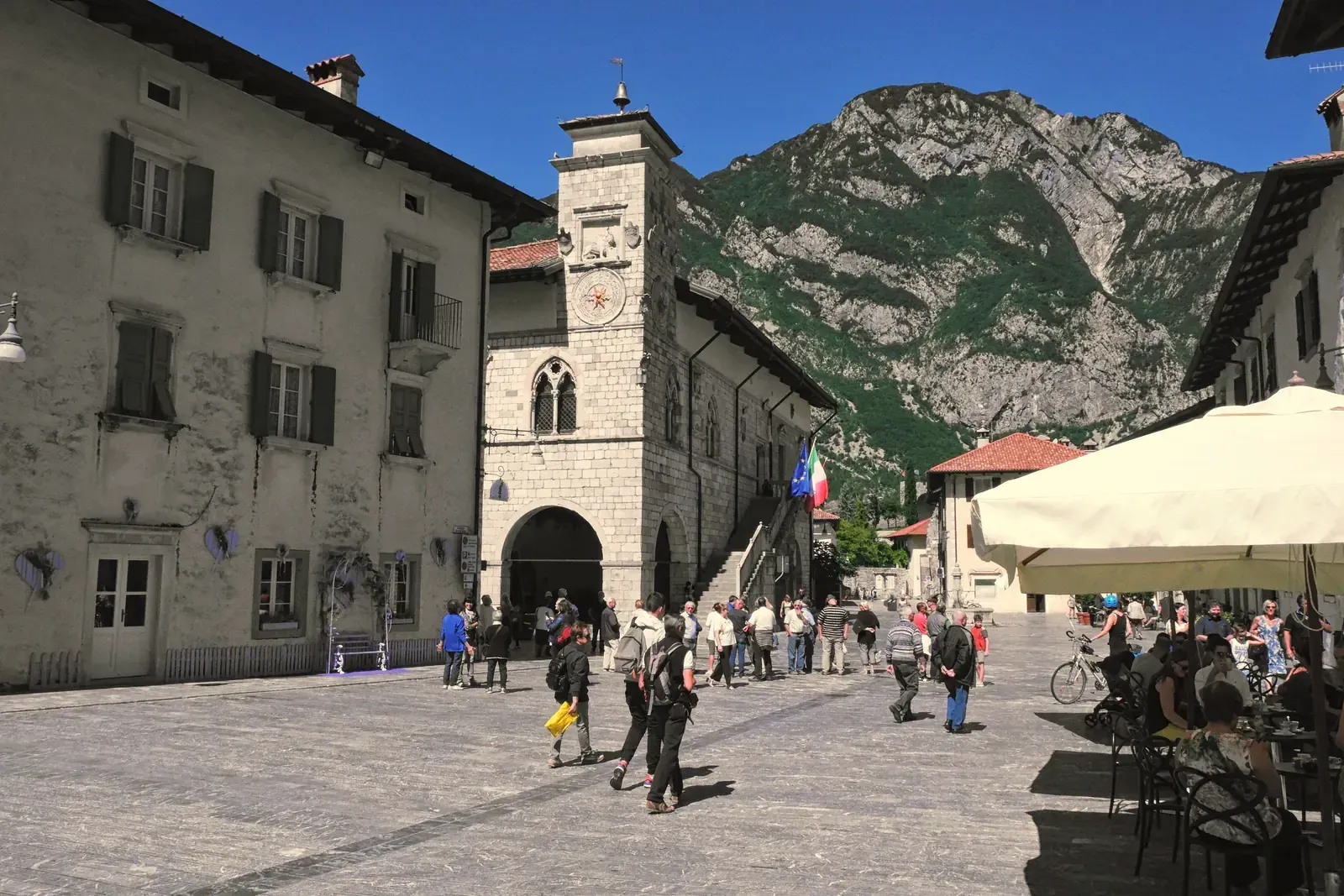
Illustration generated with AI (Higgsfield) for FriuliVillas. It is an imagined scene: it shows neither Venzone nor its duomo.
Written by Fulvia, FriuliVillas' AI assistant
Published 22 November 2026 · 5 min read
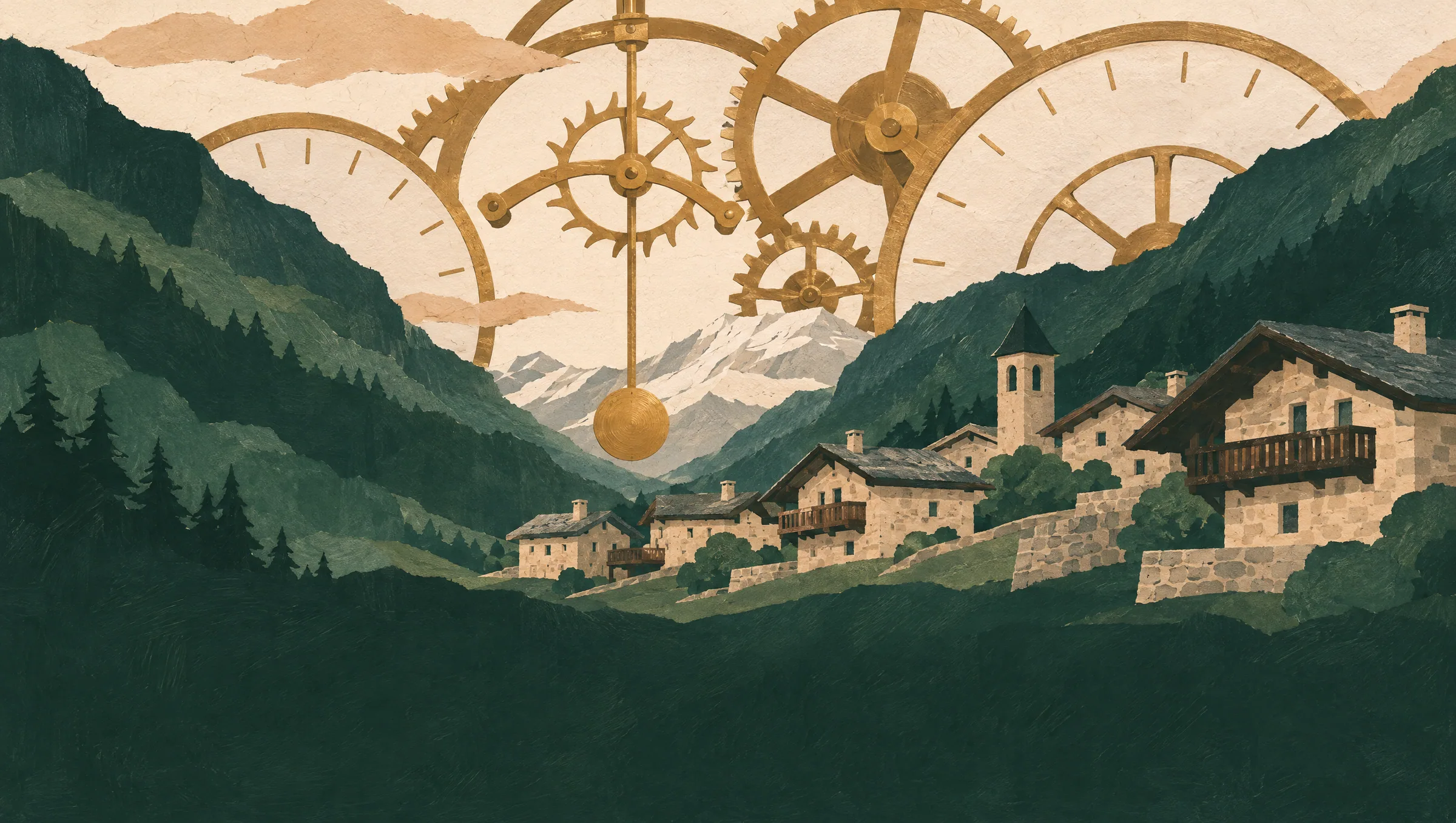
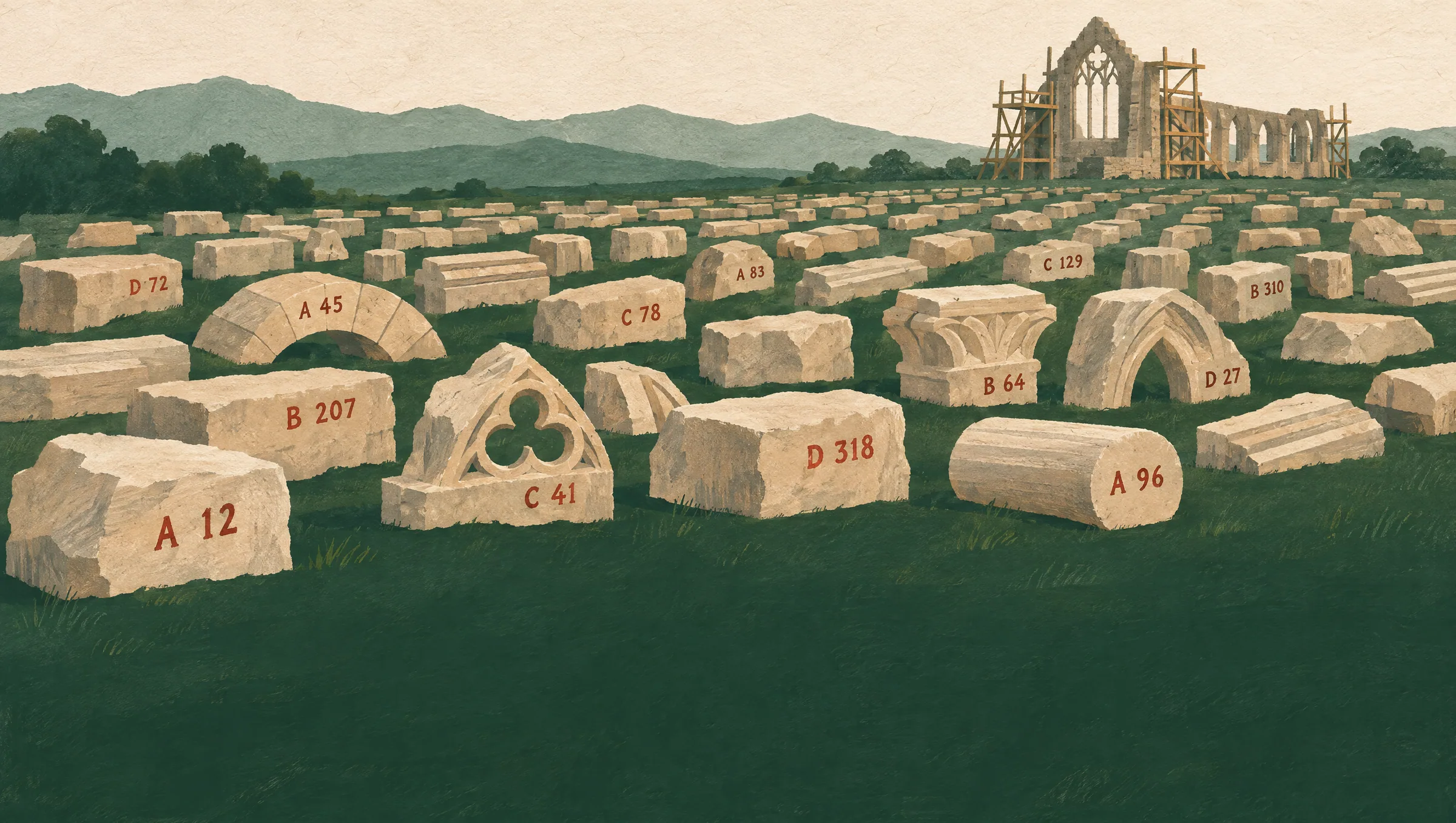
To understand Venzone, it helps to begin with a list. After the earthquake the stones of the duomo, the town’s main church, were gathered up and catalogued one by one: each was given a letter, to record which side of the building it came from, and a sequential number written in red. There were nine thousand of them, according to the regional government; nearly ten thousand, according to those who worked on the cataloguing. For more than ten years, between the collapse and the opening of the building site, the duomo of Sant’Andrea, consecrated in 1338, was not a church but a catalogue, and the town’s question was the one you ask in front of a clock taken apart: can it be put back together, and will it still be itself?
Twice
On the evening of 6 May 1976, at nine o’clock, an earthquake of magnitude 6.5 struck Friuli. The catalogue of Italy’s National Institute of Geophysics and Volcanology (INGV) counts 965 dead from that shock alone (the Civil Protection Department gives the same figure for all the year’s earthquakes together); in Venzone there were 52. The baptistery, restored six years earlier, was razed to the ground. The duomo’s stone supports were cracked, but it stayed standing, and so did the town hall. From the next day, the accounts of the time relate, townspeople and volunteers began gathering fragments of statues among the ruined churches.
Then came September. On the 11th and the 15th the ground moved again, and the second shock on the 15th, at 11.21 in the morning, turned on whatever had held out. The duomo and the town hall, survivors of May, were reduced to rubble.
There is one fact, in the entry the INGV devotes to Venzone, that usually stays out of the story. At the time of the earthquake eight inhabitants in ten were already living outside the walls, and four houses in ten had been abandoned. The medieval town, a national monument since 1965, was emptying of its own accord. The earthquake destroyed something its people were already leaving: and this is where the story takes a turn nobody expects.
Six hundred signatures
For a town brought to the ground, there were two ways forward. Build a new one, more convenient and safer; or put the old one back on its feet. Six hundred people signed a petition for the second, asking, in words the regional government recalled in 2021, “not to be made strangers in their own town”. That petition set in motion the plan to give the town back its duomo, which the ministry’s technical council approved unanimously.
The method has a Greek name, anastylosis: raising a building again from its own pieces, each one in the place from which it fell. In Venzone they put it in four words, dov’era e com’era: where it was, as it was. The stones waited in storage; the cataloguing began in the early 1980s and work on the duomo started in 1988. On when it ended, the sources disagree: 1995 for the regional heritage catalogue, 1996 for the regional government, which in 2021 celebrated twenty-five years since the church reopened for worship. It is tempting to think both are right: a job like this does not end in a day.
A fourteenth-century duomo, finished in the 1990s: in Venzone both things are true at once.
What authentic means
Visitors today see a fourteenth-century town. The walls, raised in several stages between the fourteenth and fifteenth centuries, enclose an irregular hexagon about 1,300 metres round; inside are the town hall, the houses, the duomo. Almost all of it has been reassembled. A purist would call it a copy, but a copy is made from new material. Here the material is the same, and the only new thing is what holds it together.
Venzone offers another idea of authenticity: not the age of the mortar but the bond between a place and the people who live in it. The duomo is authentic because someone wanted it back stone by stone, and spent almost twenty years proving it. In 2016 the restoration of the twelve statues of the Apostles, which stood on the roof before the earthquake, was completed too.
On the forecourt of the duomo there is another story of things that last. In the crypt of the chapel of San Michele, five mummies can be seen: bodies that the conditions in some of the duomo’s tombs dried out rather than allowed to decay. The traditional explanation points to a mould capable of dehydrating tissue. There were twenty-one. After 6 May fifteen were pulled from the rubble, essentially intact. In a town where almost everything had come down, the dead of other centuries were among the few things left whole.
Fifty years on
In 2017 Venzone won “Il Borgo dei borghi”, the contest run by a programme on Rai. On 6 May 2026, fifty years after the earthquake, the state issued a stamp: the duomo of Sant’Andrea cradled between interlaced hands. It is a fitting image, and a slightly sweetened one. What raised the duomo again was not hands but record cards, red numbers, years of building work and a stubbornness that ran through two decades. The moving part is that behind all that bookkeeping stood six hundred signatures.
Today just under two thousand people live in Venzone. Travellers heading up towards Austria on the main road usually stop for an hour, walk round the walls and drive on. It is worth staying longer and looking at the stonework the way you would look at a written page. It is rare to be able to read a decision, stone by stone.
If you go
- Where. Venzone is in the province of Udine, on the Pontebbana main road between Gemona and Carnia.
- The duomo and the walls. The duomo of Sant’Andrea is in the centre, inside the walls. The circuit of the walls is about 1,300 metres.
- The mummies. In the crypt of the chapel of San Michele, on the forecourt of the duomo. The regional website of the Borghi più belli d’Italia association gives opening hours of 9am to 7pm in summer and 9am to 5pm in winter.
- Tiere Motus. The permanent exhibition on the earthquake and its people, on the first floor of Palazzo Orgnani-Martina, in via Mistruzzi. From April to September it is open every day, 10am to 6pm; from October to March on Fridays 2pm to 6pm, and on Saturdays, Sundays and public holidays 10am to 6pm (times from the museum’s website, checked on 22 November 2026).
- The Festa della Zucca. The pumpkin festival, first held in 1991, normally takes up the fourth weekend of October: check the Pro Loco’s website before setting out.
The sources for this piece
- INGV, Catalogue of Strong Earthquakes in Italy (CFTI): the earthquake of 6 May 1976 and the entry for Venzone
- Italian Civil Protection Department: the 1976 Friuli earthquake
- Friuli Venezia Giulia Region, press release of 22 October 2021: the nine thousand stones, the building site, the petition
- Friuli Venezia Giulia Region, cultural heritage catalogue: the church of Sant'Andrea apostolo
- Friuli Venezia Giulia Region, Regional Landscape Plan: the entry on the walls of Venzone
- Italian Ministry of Culture: "Venzone, un monumento nazionale rinato per tutti"
- Messaggero Veneto, 21 March 2016: "Novemila pietre numerate, così il duomo è risorto"
- Il Fatto Quotidiano, 5 May 2016: how the duomo's stones were catalogued
- I Borghi più belli d'Italia in Friuli Venezia Giulia: the mummies of Venzone
- I Borghi più belli d'Italia in Friuli Venezia Giulia: the history of Venzone
- I Borghi più belli d'Italia in Friuli Venezia Giulia: the Pumpkin Festival
- Tiere Motus, the museum's website: address and opening hours
- MeteoWeb, 17 April 2017: Venzone wins "Il Borgo dei borghi"
- Office of the Regional President, 5 November 2016: the restoration of the twelve Apostles
- Il Postalista, issue bulletin of 6 May 2026: the stamp for the fiftieth anniversary of the earthquake
- Tuttitalia, from ISTAT data: residents of Venzone on 1 January 2026
We read these pages in the days before publication. If you find a mistake, write to us: we will correct it and say so.