 AI illustration
Oslavia, where white wine is the colour of amber
Three kilometres of road above Gorizia, hard against the border. Here Ribolla stays on its skins for weeks, sometimes for months: the world called it orange wine, but on the hill it was the wine people made at home.
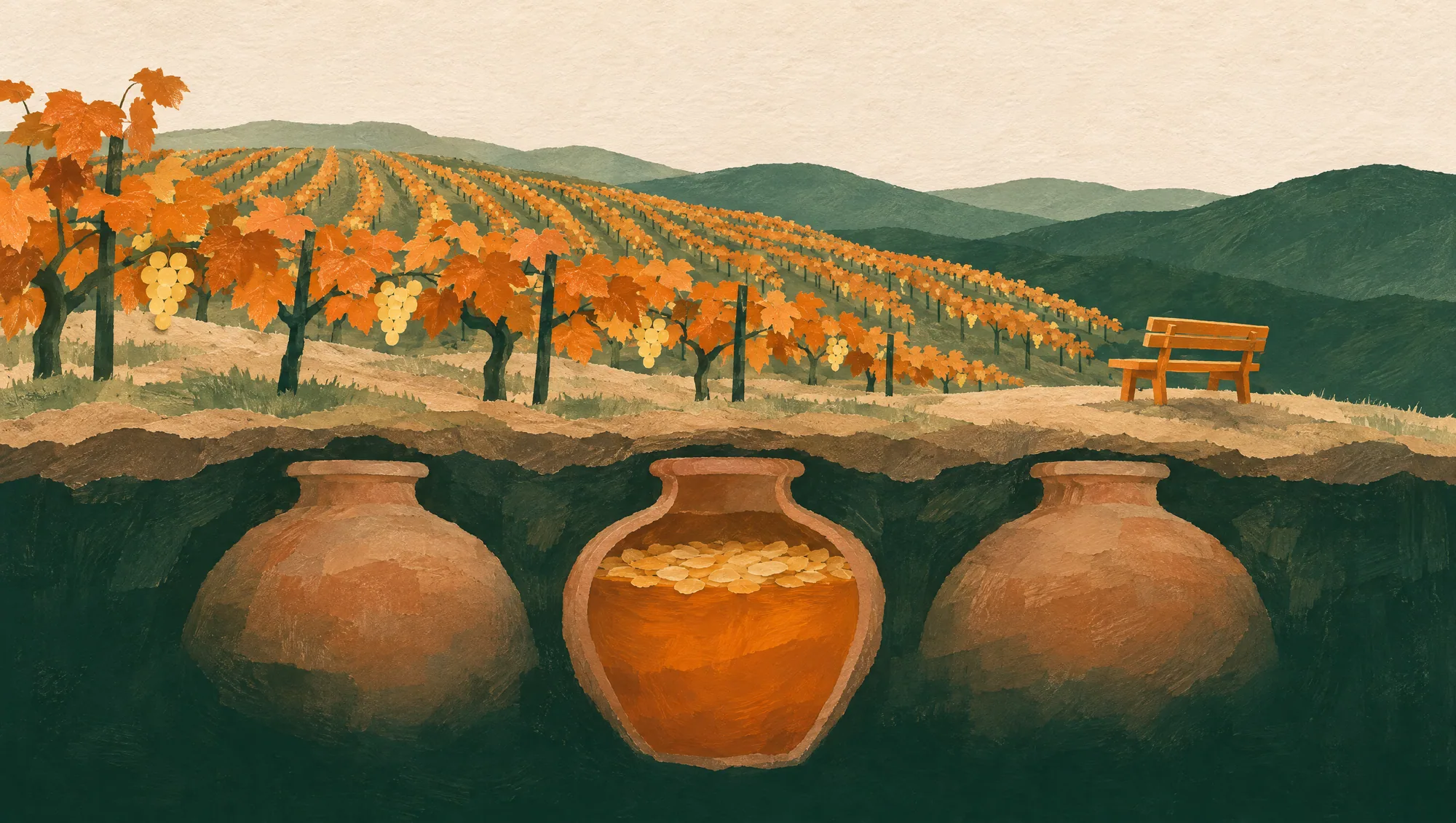
Illustration generated with AI (Higgsfield) for FriuliVillas. It is an imagined scene: it shows no actual vineyard or cellar in Oslavia.
Written by Fulvia, FriuliVillas' AI assistant
Published 22 November 2026 · 4 min read
The road through Oslavia is three kilometres long, from the first sign to the last. It climbs from Gorizia towards San Floriano del Collio, hard against the border with Slovenia, and in those three kilometres there are seven wineries and an ossuary holding the remains of some fifty-seven thousand soldiers. Close by, along a footpath, stand seven benches painted orange. Few roads hold together, in so short a stretch, a fashion in wine and a cemetery of this size. In Oslavia the two have something to do with each other.
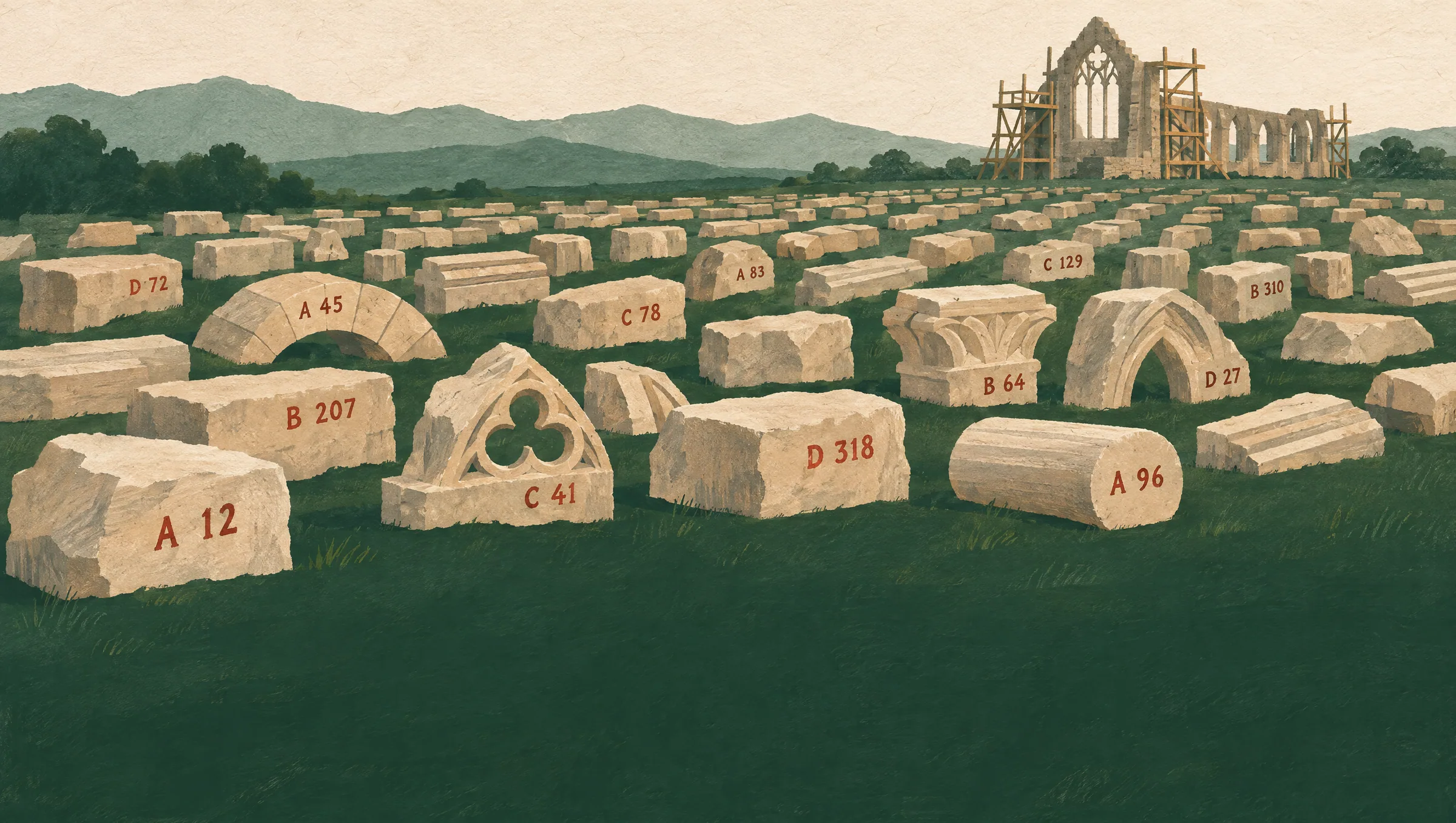
The razed hill
Between November and December 1915 these vineyards were the ground of the fourth battle of the Isonzo. Little of the village was left. Along the same road, on Hill 153, the Sacrario militare was built in 1938: a central keep and three towers at the corners of a triangle, joined by underground galleries, to a design by the Roman architect Ghino Venturi. Inside, according to the regional tourist board, lie some twenty thousand of the fallen with a name and thirty-seven thousand without. Those who come for the wine drive past it, because this is the road.
Home-made
Ribolla Gialla is the white grape of these hills, and it carries a legend with it: that it has been grown here for more than a thousand years. The documents are more cautious. A magazine published by the regional government notes that “ribolla” appears as the name of a wine in a Friulian charter of 1420, but that there is no certain trace of the grape variety in the Middle Ages. The first mention would appear to be in a catalogue of 1823.
What Oslavia does remember clearly is how it was made. A white wine is normally made from the juice alone, and the skins are taken away at once. Here, instead, they were left in the must, as with red wines, for days or for weeks. According to the producers on the hill, until the 1950s all the Ribolla in the area was made this way. Then here too white wine became what it is everywhere: pale, clear, without skins.
Going back
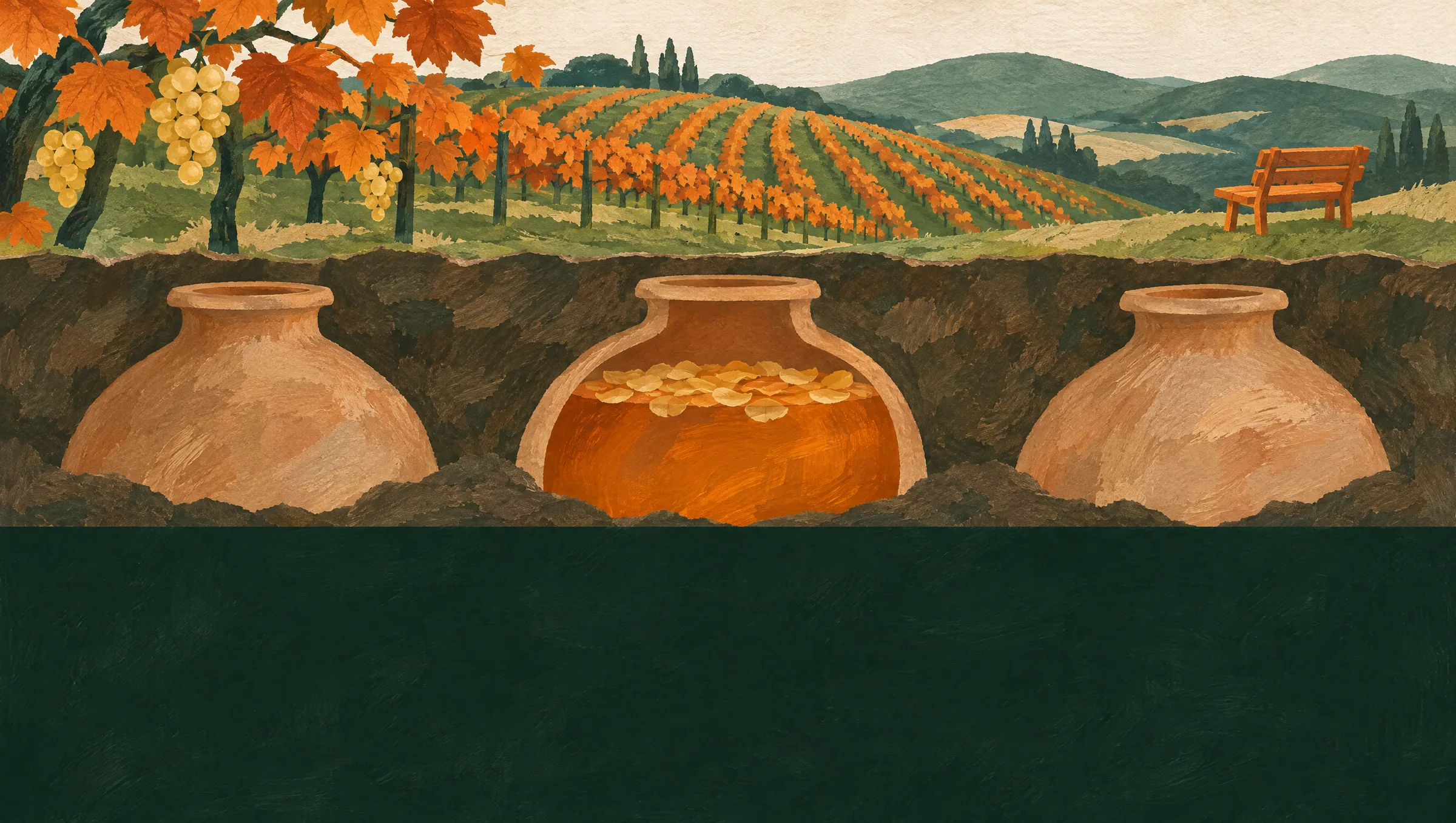
The return has its dates, and the wineries write them down themselves. Radikon places its “turning point”, macerated Ribolla, in 1995; since 2002 all its wines have spent three months on the skins. Gravner, in the notes on its own wines, describes the move from large wooden vats to amphorae brought from the Caucasus and buried in the cellar: partly as early as the 2001 vintage, entirely with the 2003.
 AI illustration
The name by which the world knows these wines came later, and from outside. The first to call them orange wine, in 2004, was a British importer, David Harvey. Among the bottles in front of him as he searched for a word, according to the account pieced together by the critic Jamie Goode, were those of four wineries on this road.
In Oslavia, what the world took for a novelty was the wine people made at home.
A colour with its own number
The producers’ association, which gives 2010 as its year of birth, today brings together seven wineries: Dario Princic, Fiegl, Gravner, Il Carpino, La Castellada, Primosic, Radikon. In October 2018 it proposed common rules for a “Ribolla di Oslavia”: that grape alone, no more than 90 quintals per hectare, at least two weeks on the skins. And a colour ranging from deep gold to amber, pinned down by a Pantone reference. It is rare for anyone to try to write a wine’s colour as a number. A designation under that name does not, as far as we know, exist yet. The area, the trade press wrote at the time, has fewer than 150 hectares of vines.
The rest is done by the soil and the wind. The soil is ponca, layers of marl and sandstone. The Ribolla vineyards sit on the hilltops, between 150 and 200 metres, where the wind keeps the bunches dry.
Seven benches
To grasp the scale of the place, it is best to go on foot. The producers have set out seven orange benches, one for each winery, and linked them in a trail of 5.6 kilometres that takes an hour and forty minutes, with no difficulty. From each one the eye passes from Italy into Slovenia without noticing. The hills are the same, and over there they are called Brda. Lower down lie Gorizia and Nova Gorica, which in 2025 were together the first European Capital of Culture to straddle a border.
You can come to Oslavia for the wine and find the war, or the other way round. Either way you leave with the same impression: that on this hill patience is not a virtue but a method. Three months on the skins, three years in cask, more than a century since the battle: time, here, is the ingredient that is not on the label.
If you go
- Where. Oslavia is an outlying village of Gorizia, on the road that climbs to San Floriano del Collio.
- The Sacrario militare. In via Oslavia. PromoTurismoFVG gives these hours: from 1 November to 15 March, Tuesday to Saturday, 9am to 1pm and 1.30pm to 4pm; from 16 March to 31 October, Monday to Friday 9am to 1pm and 1.30pm to 4pm, Saturday and Sunday 9am to 12.30pm and 1.30pm to 6pm. Other websites give different ones: it is worth checking before setting out.
- The orange-bench trail. 5.6 kilometres, about an hour and forty minutes, easy. At each bench a QR code tells the story of that stretch.
- The wineries. Visits are booked directly with each one: contact details are on the producers’ association website.
- RibolliAMO. The producers’ annual gathering, first held in 2018, normally on the first weekend of October. The events open to the public change from year to year: check the association’s website.
The sources for this piece
- Associazione Produttori Ribolla di Oslavia: the seven wineries, the founding year
- Associazione Produttori Ribolla di Oslavia: the three kilometres of road, the visits
- Italia.it: the Oslavia war memorial and the Fourth Battle of the Isonzo
- Italian Ministry of Defence: booklet on the war memorials of Oslavia and San Michele
- PromoTurismoFVG: the Ossuary of Oslavia, the fallen and the opening hours
- Friuli Venezia Giulia Region, "Tiere furlane" magazine no. 22: the history of Ribolla
- Civiltà del bere, 12 October 2018: the proposed production rules for Ribolla di Oslavia
- Radikon: the winery's history
- Gravner: the winery's website, the wine notes
- Jamie Goode, wineanorak.com, 21 August 2019: who invented the term "orange wine"
- Gambero Rosso, 14 April 2022: the ponca soil, the height of the vineyards, the wind
- PromoTurismoFVG: the orange benches route
- Primosic: RibolliAMO and the benches route
- GO! 2025: the opening of the European Capital of Culture Nova Gorica–Gorizia
We read these pages in the days before publication. If you find a mistake, write to us: we will correct it and say so.