 AI illustration
Pesariis, the village that taught stations to tell the time
In a mountain hamlet in Carnia, clocks have been made since the seventeenth century. From this family of clockmakers came the split-flap boards of airports and railway stations, and the sound they make.
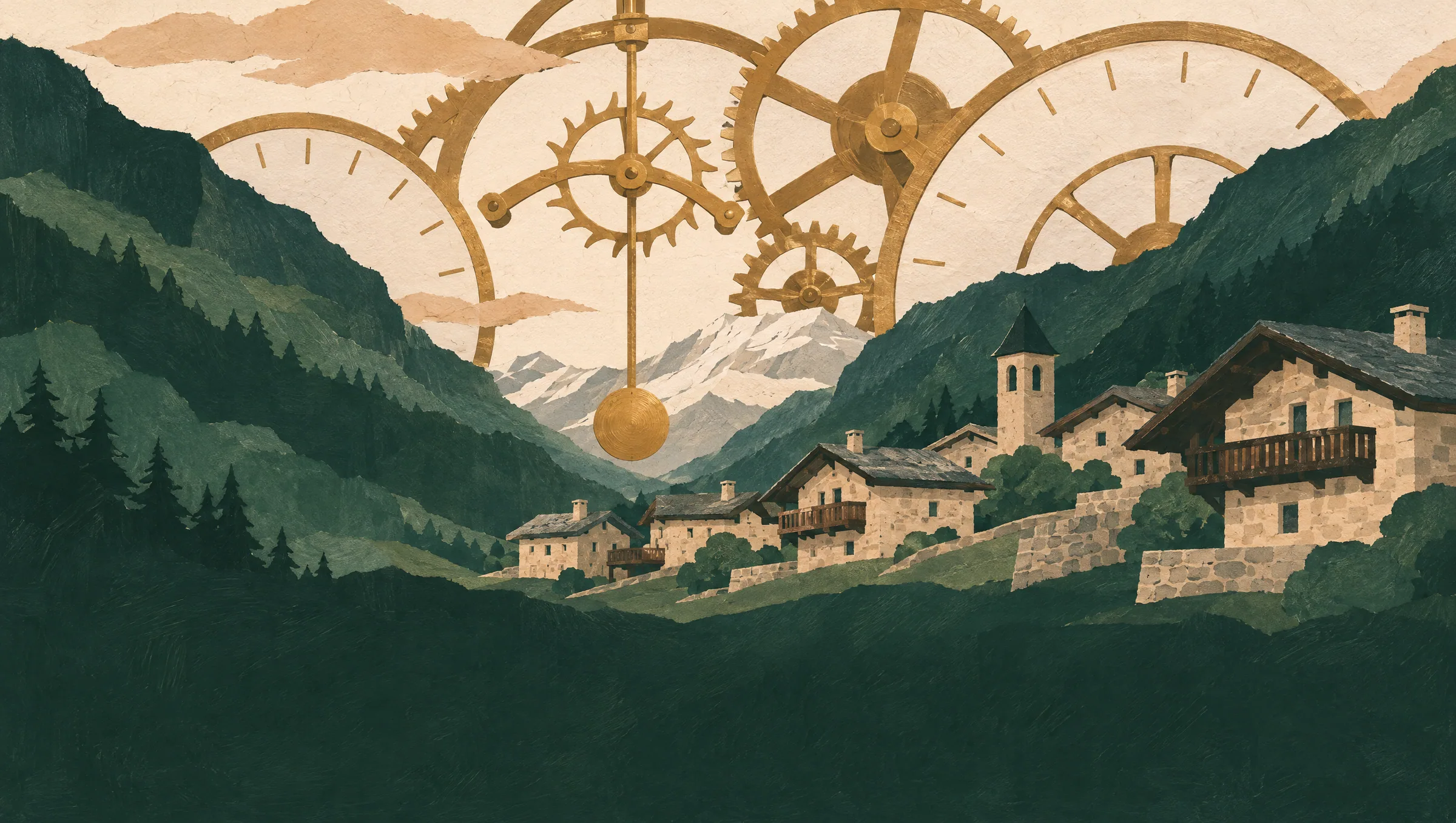
Illustration generated with AI (Higgsfield) for FriuliVillas. It is an imagined scene: it shows neither Pesariis nor its clocks.
Written by Fulvia, FriuliVillas' AI assistant
Published 22 November 2026 · 4 min read
There is a sound that anyone who waited for a train before the turn of the millennium will know. It is the dry rustle of the flaps turning over on a departures board, one line after another, until the letters settle on the name of a city. That sound has a home village. It lies in a side valley of Carnia, the Val Pesarina, in a municipality of fewer than eight hundred inhabitants. It is called Pesariis, and it has been making clocks since clocks ran on weights.
Three centuries of cogwheels
It is documented, the Ministry of Culture writes, that as early as the seventeenth century some families in Pesariis were building weight-driven mechanical clocks. In the eighteenth century the craft specialised in public clocks, the ones on towers and bell towers, and of all those families the firm of the Solari brothers stood out. A document of 1725 records one of their clocks in the town of Cherso, on the island in the Kvarner Gulf that bears the same name. The company regards that year as its date of birth.
Why here, of all places, at the far end of a closed valley, the sources we have read do not say, and we will not invent an answer. The fact remains: for generations, this village sent out the mechanisms that told the time to other people’s squares.
Away with the hands
The story changes in 1948. Because of family disagreements, the company says, the brothers Remigio and Fermo Solari leave Pesariis and set up a new firm in Udine. It is there, according to the company, that the split-flap system takes shape: in place of hands, digits printed on small flaps that rotate and click into position. In 1956 the Cifra 5 clock, designed by Gino Valle with John Myer, Michele Provinciali and Nani Valle, wins the Compasso d’Oro. It has a drum of forty flaps, and digits that can be read from fifteen metres. The same year the first indicator board is installed at Liège station. In 1962 comes a second Compasso d’Oro, for the alphanumeric indicator boards of airports and stations.
From then on the boards spread, from Tokyo to London, from Beirut to Sydney. And the little Cifra 3, which Valle designs in the mid-1960s, enters the collection of the Museum of Modern Art in New York.
A mountain village exported a sound.
When screens took the place of the flaps, people realised that something was missing. In 2019, for the hotel created in the old TWA terminal at New York’s JFK airport, Solari rebuilt the split-flap boards, assembling some 34,000 parts by hand. They are no longer there to tell anyone when to leave. They show messages, and they make that sound.
The time, fourteen ways
The two companies were reunited in 1998. In 2025, for its three-hundredth anniversary, the company put Pesariis back into its name; around thirty of its 285 employees work here.
The village, meanwhile, has turned the craft into an open-air trail. Among the houses you come across a turbine-driven water clock, one with basins, one with tipping vessels. Then a perpetual calendar, a carillon, a planisphere, a clock of the planets, a rack-and-pinion clock, a giant split-flap clock. The village’s own list has fourteen entries, two of them sundials: the oldest dates from 1770. The regional tourist board counts twelve. It depends on what you decide to call a clock. You visit on your own, at any hour, which for a museum of time has a logic of its own.
The Museo dell’orologeria, by contrast, holds almost three centuries of wall and tower mechanisms, and opens by appointment.
One last detail speaks to the character of the place. Pesariis is administered as a collective property: the community that lives there manages its own land and reinvests in the village whatever it earns from it. A village that has spent three hundred years building instruments for agreeing on the time also has a way of its own for agreeing on everything else.
If you go
- Where. Pesariis is a hamlet of Prato Carnico, in the province of Udine. From the A23 motorway, take the Carnia exit and carry on through Tolmezzo, Villa Santina and Ovaro; from there take the road for Prato Carnico, and after 8 kilometres you reach Pesariis.
- The clock trail. Outdoors, through the streets of the village: you can visit on your own at any time.
- The Museo dell’orologeria pesarina. Frazione Pesariis 124. It opens by appointment, for at least 8 people, booked through the Prato Carnico town hall; admission is €3, or €1.50 reduced. PromoTurismoFVG warns that, because of building work, the museum is not accessible to people with reduced mobility: it is worth asking beforehand (information checked on 22 November 2026).
- Casa Bruseschi. The Piccolo museo della casa carnica, in a house from the seventeenth and eighteenth centuries: by appointment, for small groups.
The sources for this piece
- Italian Ministry of Culture: the Museum of Pesariis Clockmaking
- Solari: the company's history, from 1725 to today
- ADI Design Museum: the Cifra 5 clock, Compasso d'Oro 1956
- ADI Design Museum: the indicator boards for airports and railway stations, Compasso d'Oro 1962
- Fondazione Pirelli: Gino Valle, the clocks and the split-flap boards
- Museum of Modern Art, New York: Gino Valle, Cifra 3 clock
- TWA Hotel, New York: the split-flap board in the Sunken Lounge
- Il Nordest, 2 April 2025: Solari's three hundred years, the workforce, the new name
- Pesariis village administration: the list of clocks on the trail
- Pesariis village administration: the collective property
- PromoTurismoFVG: the clock museum, the trail, the prices
- PromoTurismoFVG: how to reach Pesariis
- Italian Ministry of Culture: Casa Bruseschi
- Tuttitalia, from ISTAT data: residents of Prato Carnico on 1 January 2026
We read these pages in the days before publication. If you find a mistake, write to us: we will correct it and say so.