 AI illustration
Spilimbergo, the school founded for those who had to emigrate
Since 1922 the Scuola Mosaicisti del Friuli has taught students to cut stone with blows of the mosaicist’s hammer. It set out to give a trade to those who were leaving; today almost half its students come from abroad to learn it.
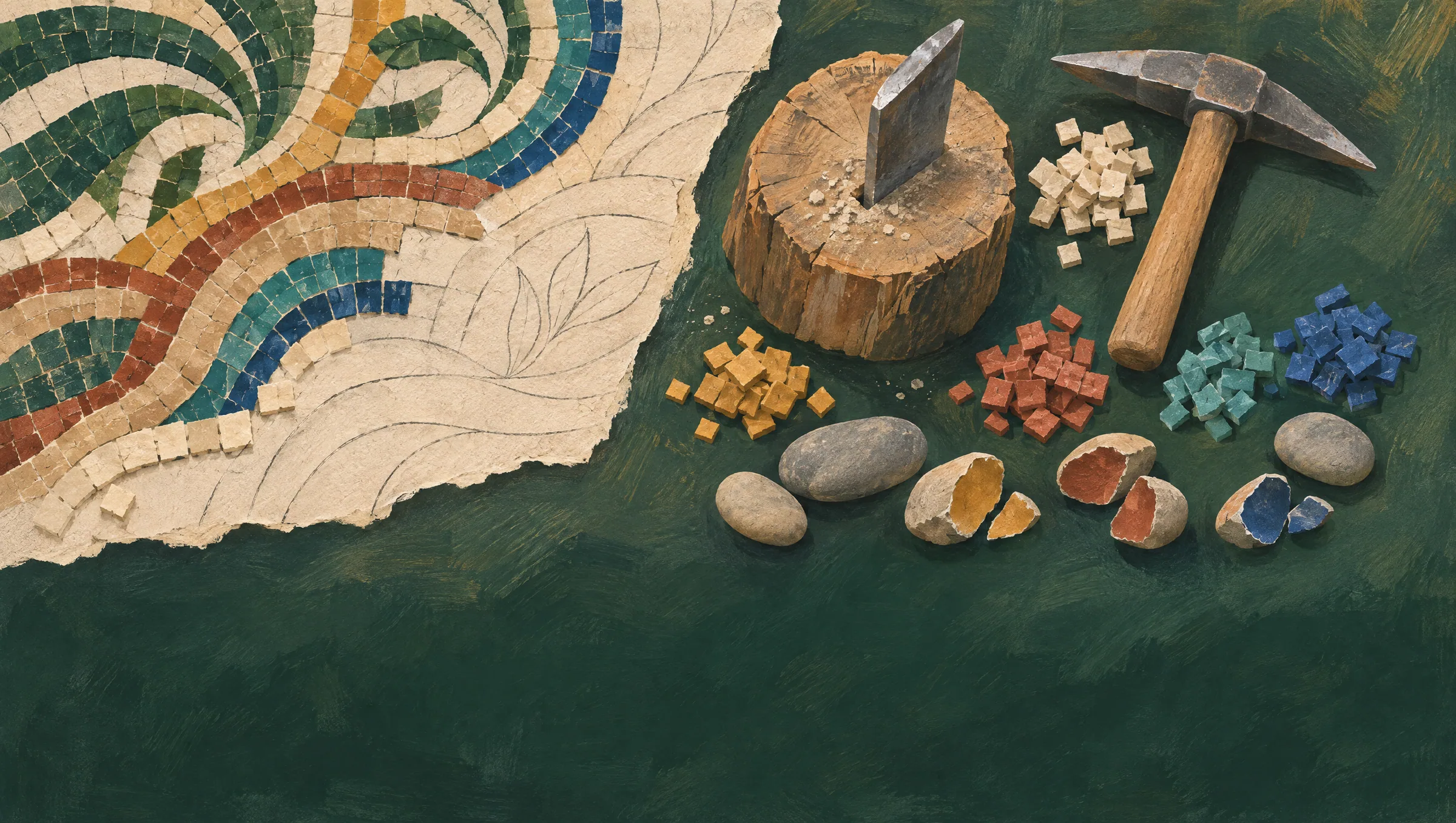
Illustration generated with AI (Higgsfield) for FriuliVillas. It is an imagined scene: it shows no actual work or workshop of the School.
Written by Fulvia, FriuliVillas' AI assistant
Published 22 November 2026 · 4 min read
From the outside, a river stone is nearly always grey. You have to split it to find out what colour it is. The terrazzo workers of the Spilimbergo district had known this for centuries: before leaving for the season in Venice they went down to the gravel beds of the Meduna and the Tagliamento, chose their pebbles and took them along. In Spilimbergo there is a school that for more than a hundred years has been teaching people to do the same thing, and to do it for a living.
A trade to take away
The Scuola Mosaicisti del Friuli opened on 22 January 1922. The idea came from Lodovico Zanini, the Friuli delegate of Milan’s Società Umanitaria, and the mayor, Ezio Cantarutti, made it happen. The first students numbered thirty-eight. The founders had no illusions. The school, the institution writes today in its account of those days, would not reduce the number of emigrants; it could, however, give them a qualification, so that they left as skilled workers.
It is an idea that says a great deal about the Friuli of that time. Since the nineteenth century the mosaicists of these villages had travelled far beyond Venice: to France, the United States, Canada, Venezuela, Argentina, Australia. The most famous of them, Gian Domenico Facchina, was born in the nearby village of Sequals on 13 October 1826, two hundred years ago.
Facchina’s invention
Facchina changed the trade with a bookkeeper’s idea. A mosaic, as a rule, was assembled on site, tessera by tessera. In 1852, in his workshop in Béziers, he worked out another way: composing the design in reverse, lightly gluing the tesserae onto a sheet of paper, then carrying it to its destination and setting it in the bed of mortar. The Dizionario biografico dei friulani notes that the method brought the cost of mosaic down considerably. Demand grew. Once he had moved to Paris, Facchina was entrusted by the architect Charles Garnier with the decoration of the Opéra, inaugurated on 5 January 1875.
When the School opened, its first mosaic teacher was Andrea Avon, who had worked alongside Facchina. Since then the “reverse on paper” technique has never stopped being taught.
A mosaic made this way can be born in a workshop in Friuli and end up on the other side of the world.
Where the stones ended up
That is why the School’s largest works are far from here. In the 1930s it carried out the cycle at the Foro Italico in Rome: almost ten thousand square metres, by its own count, from cartoons by Angelo Canevari, Giulio Rosso, Gino Severini and Achille Capizzano. Among the works it lists are the covering of the dome of the Holy Sepulchre in Jerusalem, about 345 square metres, 1,600 square metres of mosaic for a hotel in Japan, and the paving of the Piazza della Transalpina, the square that Gorizia and Nova Gorica share.
And there is the Saetta iridescente (“Iridescent Lightning”). After 11 September the Friuli Venezia Giulia Region wanted to give a gift to the city of New York: a mosaic in the shape of a lightning bolt 118 feet long, about 36 metres, and more than three and a half metres high, with over 1.4 million tesserae. It was made by students on the advanced courses with their teachers, under the direction of the artist Giulio Candussio. Ninety days to make it, two weeks to install it, in 2004. In 2016, when the new station opened, it was moved to run alongside Track 1 of the World Trade Center PATH station: that is where the authority that runs the station described it as being the following year.
Who studies there today
The course lasts three years, at thirty-eight hours a week: mostly mosaic and terrazzo, but also drawing, geometry, the history of mosaic and computer graphics. Students are admitted between the ages of eighteen and forty, with forty places at most each year. On 28 September 2026 what the School counts as its hundred and sixth academic year began, with some ninety students. Of these, 46 per cent come from abroad: from France and Germany, but also from Australia, Iran, Vietnam and Sri Lanka.
A hundred years ago, the School recalls, young people cycled in from the surrounding villages to learn a trade they would take abroad. Now people leave other countries to come and learn it here. It is hard to find a more exact measure of how much this region has changed. And of what has stayed the same: a hammer, and a stone to break open.
If you go
- The School. Via Corridoni 6, Spilimbergo, in the province of Pordenone. Self-guided visits from Monday to Friday, 8am to 12 noon (last entry 11.30am) and 1pm to 4pm (last entry 3.30pm), for a contribution of €3. Inside are the gallery, with more than eight hundred works, and the classrooms where the students work (from the School’s website, checked on 22 November 2026).
- Guided tours. Every day, public holidays included, but only by booking through the Spilimbergo tourist office.
- In town. The Duomo of Santa Maria Maggiore, begun in 1284, and the castle, built to guard a ford on the Tagliamento, with the Palazzo Dipinto.
- Sequals. Facchina’s village, a little further north.
The town in figures: Spilimbergo
The sources for this piece
- Scuola Mosaicisti del Friuli: history and present day
- Italian General Catalogue of Cultural Heritage: the mosaics of the indoor pool at the Foro Italico (1934–1936)
- Scuola Mosaicisti del Friuli: the opening on 22 January 1922 and the emigrants
- I Borghi più belli d'Italia in Friuli Venezia Giulia: the School, the first 38 pupils
- Dizionario biografico dei friulani: entry "Facchina, Gian Domenico"
- Scuola Mosaicisti del Friuli: two hundred years since the birth of Gian Domenico Facchina
- Opéra national de Paris: the Palais Garnier
- Port Authority of New York and New Jersey: "Iridescent Lightning" at the World Trade Center PATH station
- Scuola Mosaicisti del Friuli: the three-year professional course
- Scuola Mosaicisti del Friuli: the 106th school year opens (September 2026)
- Scuola Mosaicisti del Friuli: the gallery, visits, opening hours
- Scuola Mosaicisti del Friuli: the 2022 centenary
- Avvenire, 13 March 2022: the School at one hundred, the mosaic hammer, the figures
- I Borghi più belli d'Italia in Friuli Venezia Giulia: the cathedral of Santa Maria Maggiore
- PromoTurismoFVG: Spilimbergo castle
We read these pages in the days before publication. If you find a mistake, write to us: we will correct it and say so.