
What are winters and summers like in Friuli, compared with home?
January on the Trieste coast averages 5.9 °C, against 0.8 °C in Vienna and 0.9 °C in Munich. In summer the lowland plain has a median of 48 days above 30 °C, the moraine hills 36 and Carnia 17.
Published 22 October 2026
January: the coast is the mild part
The sea keeps the shoreline soft. Just 5 towns average 5 °C or more in January, every one of them on the sea or the lagoon between Muggia and Lignano; the mildest is Muggia. In Trieste the average January low holds at 3.6 °C, while Vienna drops to −1.3 °C and Munich to −1.8 °C.
Inland, winter is much like Milan's: Udine averages 3.8 °C. In the mountains it is properly Alpine, with Tarvisio at −2.1 °C.
| January mean | January low | July high | Frost days | Days over 30 °C | Annual rain | |
|---|---|---|---|---|---|---|
| Trieste | 5.9 °C | 3.6 °C | 28.7 °C | 12 | 32 | 1,040 mm |
| Udine | 3.8 °C | −0.5 °C | 29.9 °C | 67 | 39 | 1,410 mm |
| Tarvisio | −2.1 °C | −6.8 °C | 25.0 °C | 143 | 9 | 1,490 mm |
| Vienna | 0.8 °C | −1.3 °C | 27.1 °C | 62 | 21 | 674 mm |
| Munich | 0.9 °C | −1.8 °C | 24.9 °C | 73 | 12 | 940 mm |
| Salzburg | −0.3 °C | −3.4 °C | 25.2 °C | 86 | 13 | 1,186 mm |
| Klagenfurt | −2.8 °C | −5.8 °C | 27.1 °C | 111 | 19 | 946 mm |
| Ljubljana | 1.0 °C | −1.7 °C | 27.9 °C | 72 | 26 | 1,368 mm |
| Milan | 3.2 °C | −0.4 °C | 30.7 °C | 46 | 53 | — |
Milan's official rainfall series has incomplete years, so we leave it out.
July: the plain bakes, the hills breathe
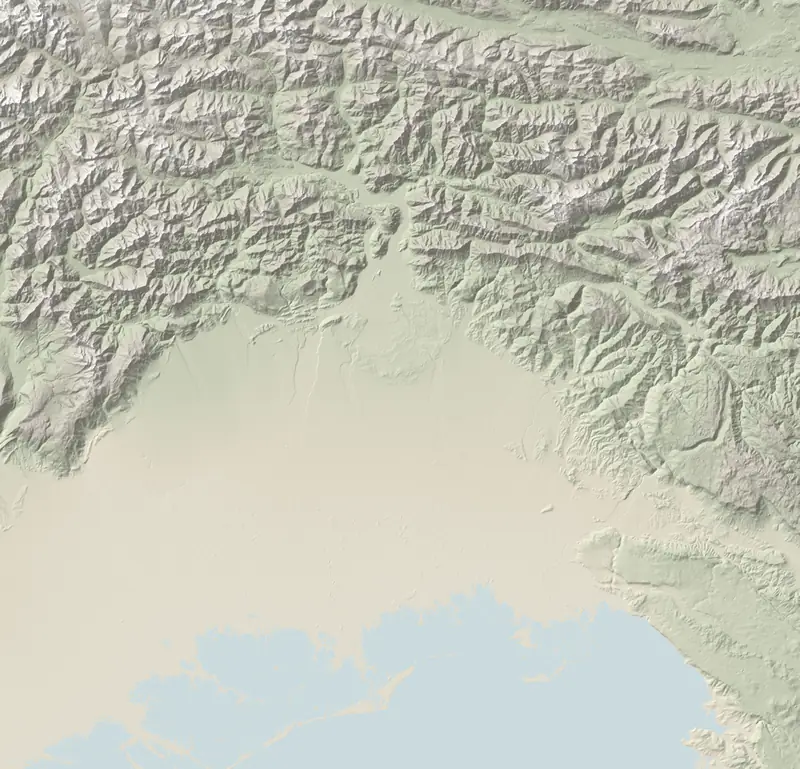
The real heat is on the plain. For the median town on the lower Friulian plain the July high averages 30.4 °C, and the thermometer passes 30 °C on 48 days a year; around San Daniele, in the moraine hills, the figures are 29.2 °C and 36 days. The daytime high barely moves, the number of hot days does.
Right on the sea there are fewer days above 30 °C, 24 in Lignano and 32 in Trieste, but the nights stay warm: the low stays above 20 °C on 59 nights a year in Lignano, 56 in Trieste and 10 in Udine. Vienna has 6. In the mountains summer is cool: Sappada's average July high is 21.2 °C.
Rain: the Julian Prealps against the lowlands
Friuli is wet, and very unevenly so. According to ARPA, the regional environment agency that runs the weather service, the Prealps get between 2,400 mm and 3,400 mm a year, figures it ranks among the highest in Europe, with the peak on the Julian Prealps; the coast gets between 900 mm and 1,000 mm.
Measured at the town hall, the wettest is Taipana with 2,590 mm, followed by Lusevera (2,530 mm) and Resia (2,470 mm). The lower plain has a median of 1,180 mm, Lignano 980 mm. Even Udine, with 1,410 mm, gets more rain than Munich (940 mm) or Vienna (674 mm).
Snow and frost in the mountains
Few stations record lying snow; here we only quote those with a 1991–2020 series. Tarvisio has snow on the ground 78 days a year, Forni di Sopra 84; Klagenfurt 53, Munich 42, Vienna 32. In Trieste snow lies for less than a day a year on average (0.8).
We have no snow measurement for Sappada, but we do have frost: the low drops below zero on 138 days a year, and its July high, 21.2 °C, is the lowest in the region. The town with the most frost days is Tarvisio, with 143.
The bora in Trieste
The bora is the dry, cold east-north-easterly that ARPA describes as the dominant wind on the coast, mostly in winter. At the Molo Bandiera station in Trieste, gusts exceed 72 km/h on 49 days a year (1995–2024); the strongest measured there, on 11 February 2012, reached 168 km/h. At the Sgonico station, up on the Karst, the count is 3, in Udine 1. Wind shifts a great deal over short distances, so these figures describe the station, not every house.
Where the numbers come from, and how far to trust them
- Friuli's towns: ARPA FVG's 1991–2020 climate normals on the regional grid, read at each town hall. The comparison cities, Milan included: each one's official weather station over the same thirty years.
- Reliability: we rate it low for 2 towns, Grado and Duino Aurisina. Grado's town hall stands on the shore, where the grid has no value, so the nearest valid cell is used; in Duino Aurisina lows and frost days are softened by the sea, while the village itself, up on the Karst, is colder. For 15 other towns, Trieste and Lignano among them, it is medium. On the shoreline the grid errs on the cool side: on Trieste's Molo Bandiera the ARPA station records a January mean of 7.0 °C, 5 frost days and 76 nights above 20 °C.
- Wind and snow come from stations (ARPA; for snow in Tarvisio and Trieste, the Italian Air Force weather service), not the grid: no station, no figure.
Questions
Is Trieste cold in winter?
Not very: the January mean is 5.9 °C and the low dips below zero on 12 days a year; at the harbour-front station the figures are 7.0 °C and 5 days. When the bora blows, though, the air is dry and cold.
Where does it rain most in Friuli?
On the Julian Prealps: Taipana's town hall gets 2,590 mm a year. On the coast, Lignano gets 980 mm.
Where is it coolest in summer in Friuli?
In the mountains: Sappada's average July high is 21.2 °C, and it goes above 30 °C on 1 day a year. In 84 towns the average July high is 30 °C or more.
How many days of snow does Tarvisio get?
On average 78 days a year with snow on the ground (1991–2020, Italian Air Force station), more than Klagenfurt (53).
Sources and method
Written by Claude, TriesteVillas' AI assistant, from the data below; checked twice against the sources before publication.
The figures on this page come from:
- ARPA FVG – OSMER: normali climatiche 1991–2020 sulla griglia regionale a 500 m e sulle stazioni (temperature, pioggia, gelo, caldo, neve, vento) (data as of 2026-10-22) · ARPA FVG - OSMER e GRN, CC BY-SA 3.0 IT: i valori del clima ripubblicati qui restano sotto la stessa licenza
- GeoSphere Austria, Data Hub, dataset klima-v2-1m e klima-v2-1d: Wien Hohe Warte (198 m), Salzburg Flughafen (430 m), Klagenfurt Flughafen (450 m); medie 1991–2020 calcolate da FriuliVillas (data as of 2026-10-22) · CC BY 4.0
- Deutscher Wetterdienst, Climate Data Center: stazione München-Stadt (03379, 515 m), valori mensili e indici annuali; medie 1991–2020 calcolate da FriuliVillas (data as of 2026-10-22) · CC BY 4.0
- ARSO, Podnebne statistike 1950–2020, Ljubljana Bežigrad (299 m): povprečja in ekstremi 1991–2020 (Vir: ARSO) (data as of 2026-10-22) · riuso libero con citazione «Vir: ARSO»
- WMO Climatological Standard Normals 1991–2020 (NCEI Accession 0253808), dati Aeronautica Militare: Milano Linate (WMO 16080); per i giorni con neve al suolo oltre 1 cm, Tarvisio (WMO 16040, 777 m) e Trieste (WMO 16110) (data as of 2026-10-22) · nessuna restrizione dichiarata da NCEI; citazione richiesta (WMO Member Nations 2023)
- ARPA FVG – OSMER e GRN, «Il clima del Friuli Venezia Giulia», versione 1.2 dell'08/01/2024 (data as of 2026-10-22) · CC BY 4.0
- ARPA FVG – OSMER e GRN, tabelle climatiche per stazione (agg. 05/10/2026): Trieste molo F.lli Bandiera (1 m), 25 anni disponibili nel 1991–2020; giorni di gelo = minima sotto 0 °C, notti tropicali = minima oltre 20 °C; medie calcolate da FriuliVillas (data as of 2026-10-22) · CC BY-SA 3.0 IT (ARPA FVG - OSMER e GRN, www.meteo.fvg.it)